In this one-day lesson, students will examine the main events and defining characteristics of the Age of Oil.
THIS UNIT
Browse unit contents using the tabs to the right or the filters below.
Share
Tell other teachers, parents, and students about us.
Follow
Pacing
Total Length of all materials in the Unit: 23 days
- 11 Estimated Instructional Days
- 9 Optional Extension Days
- 3 Optional review days prior to assessment
Just the Basics:
- The Big Picture (1 class period)
- Vocabulary (2 class periods)
- What’s the Story? (1 - 2 class periods)
- The Hurricane of 1900 (1 class period)
- Oil Transforms Texas (1 class period)
- The Progressive Movement (1 class period)
- World War I Guided Notes (2 class periods)
Contents
Era Overview
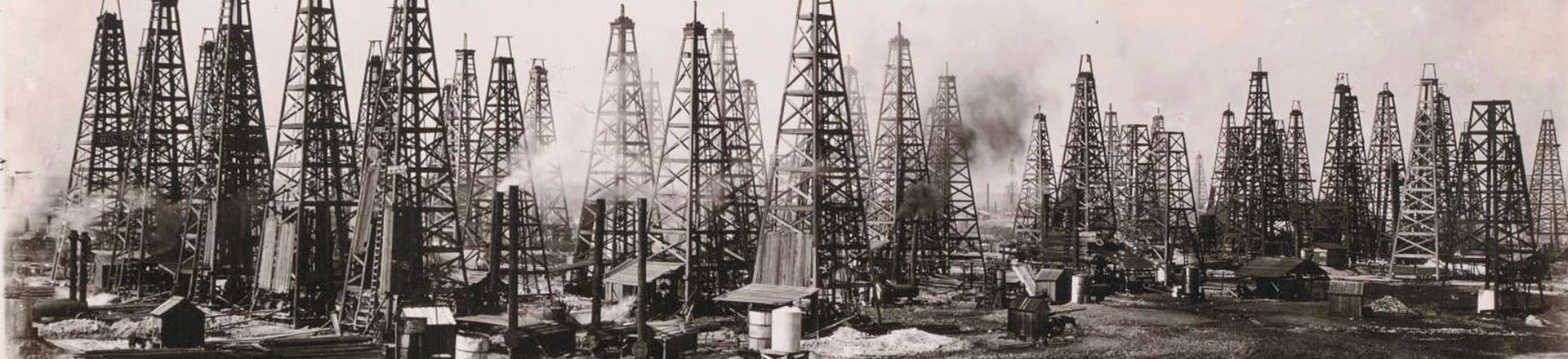
The early decades of the twentieth century (the Age of Oil, 1901-1929) was a period of tremendous change for Texas. It all began on January 10, 1901, when drillers discovered a massive pocket of oil at a place called Spindletop in east Texas. The discovery of oil changed Texas forever, setting off a wild new era of boomtowns and oil derricks that transformed the state. During the thirty years that followed, people flooded into Texas as oil strikes created new towns and cities across the state. With so much change going on, a new movement emerged during these years called “Progressivism.” Some Progressives wanted to clean up cities and make them more comfortable places to live. Others wanted to make it easier for farmers to make a living and keep their land. Still others wanted to do things like outlaw alcohol, which Progressives thought caused a lot of problems in society.
One of the great successes of the Progressives was securing women the right to vote. In 1918, a woman named Annie Webb Blanton became the very first woman ever to hold statewide office in Texas. Just one year later, Texas became the first Southern state to ratify the Nineteenth Amendment to the U.S. Constitution, which officially gave women the right to vote nationwide. In 1924 Texas even elected its first female governor, Miriam Ferguson. At the same time, other Texans struggled during these early decades of the 1900s. Many farmers in Texas, for example, lost their homes because low cotton prices meant they couldn’t afford to keep their land. At the same time, the state legislature passed new laws that that made it nearly impossible for many people, especially people of color, to vote in elections.
The Age of Oil was, in other words, a period of tremendous upheaval and change. There were even two massive wars that took place during these years, World War I and the Mexican Revolution, that each helped to remake Texas.
Other Units
Lessons
Most lessons contain downloadable and printable documents, activities, and other resources to aid in classroom instruction. Lesson materials are available in multiple formats and typically contain variations based on learning needs. Learn more about alternative formats here.

The Big Picture
Unit Plan # 1
45-60 min
none
71A
71B
77A
77C
77E
711A
720A
720B
721A
722C

How Do We Know What We Know?
In this one-day, primary source lesson, students will analyze a set of ten excerpts related to major topics and events of the Age of Oil.
Unit Plan # 2
45-60 min
none
71A
71B
77C
77E
79A
720A
720B
722B

Vocabulary
In this two-day lesson, students will be able to identify, define and give an example of each vocabulary term within the context of the Age of Oil.
Unit Plan # 3
90-165 min
none
71B
77C
711A
720A
720B
720C
720E
722A
722B

What's the Story?
In this two-day lesson, students will examine six readings presenting significant events that took place during the Age of Oil and identify their significance to United States and Texas history.
Unit Plan # 4
90-120 min
none
71A
71B
77C
77E
79B
711A
720A
720B

Who's Who of the Age of Oil
In this one or multi-day optional extension lesson, students will read passages about key people of the Age of Oil to identify and summarize each person’s significance to the era. This lesson includes multiple ways to interact with the materials includingbiographical fact sheets, a dinner party activity, “I have / Who has” and student worksheets.
Extension
45-180 min
none
77C
77D
719C
720B
720D

The Hurricane of 1900
In this one-day lesson, students examine the events of the hurricane of 1900 to determine the factors that contributed to the devastation of Galveston, the recovery efforts, and the long term significance of the hurricane on Galveston and Texas.
Unit Plan # 5
45-60 min
none
79A
79B
720A
720B

Oil Transforms Texas
In this one day lesson, students will use the information provided in the notes in the slideshow to determine various ways in which the 1901 discovery of oil at Spindletop transformed Texas both economically and socially.
Unit Plan # 6
45-60 min
none
71B
77A
77B
711A
720A
720B
720C
721A
721B

The Progressive Movement
In this one- or two-day stations lesson, students will examine the development of the Progressive movement in the U.S. and Texas and be able to determine how Progressives influenced Texas politically, socially, and economically.
Unit Plan # 7
45-90 min
none
77C
720A
720B
720C
722D
723A

World War I Guided Notes Extension
In this two-day lesson, students will use notes from the slideshow to answer questions to identify key information, summarize main ideas, provide cause-and-effect relationships, and explain the significance of topics related to World War I. This is a non-traditional guided notes lesson. Notes are already provided on student work.
Extension
45-60 min
none
77E
711A
720A
720B
720C
721A

Choctaw Code Talkers Extension
In this optional, one-day extension lesson, students will examine the communication challenges the U.S. Army faced during World War I and how American Indians like the Choctaw successfully used their indigenous languages to overcome these challenges, helping lead the U.S. and the Allies to victory in World War I.
Unit Plan # 8
45-60 min
none
77E
720A
720B
720E

The Mexican Revolution Extension
In this one-day optional extension lesson, students will learn about the causes, important individuals, and effects of the Mexican Revolution, with specific emphasis on how the war affected Texas history.
Extension
45-60 min
none
720A
720B
720E

Zimmerman Telegram Readers Theater Extension
In this optional one-day extension lesson, students will examine the key events of the Zimmerman Telegram by taking part in a readers theater activity and answering questions related to the significance of various aspects of the events. There is an additional optional project in which students choose to create a storyboard, a newspaper article, or an interview related to the events.
Extension
45-60 min
none
77D
720A
720B
720E

Texas Today
In this one day lesson, students will examine the innovative use of horizontal drilling technology and the effects this method has had on the Texas economy.
Unit Plan # 9
45-60 min
none
719D
720B
720C
720E
721A
721B

Looking Ahead
In this one day lesson, students will examine the stock market crash of October 29, 1929, that led to the Great Depression and analyze how this event caused a new era in Texas and U.S. history. Students will be introduced to the major concerns and challenges that faced most Americans during the Great Depression.
Unit Plan # 10
45-60 min
none
71A
77E
720A
720B
720C
721A

Study Guide and Flashcards
In this one-day optional review lesson, students will identify the significance of key terms, cause and effect relationships between significant events, and answer practice test questions to prepare for the unit 11 test.
Review
45-60 min
none
71B
77A
77C
77D
77E
79A
79B
711A
719B
720A
720B
720C
720E
721A
722A
722B
722C

Review Bingo Game
In this one day review lesson, students will review key terms, ideas, people, places, events, and major themes of the Age of Oil by playing Bingo using terms from the unit and clues about each term.
Review
45-60 min
none
71B
77A
77C
77E
79B
711A
719B
720B
722B

Review Mind Map
In this one-day optional review lesson, students will create a visual representation of terms and concepts from the unit in the form of a mind map. Students will be able to identify how information from the unit is connected by making connections between terms on a Mind Map.
Review
45-60 min
none
71A
77A
77C
77D
77E
79B
711A
719B
720B
720E
721A
722A
Maps
We've assembled the following list of maps that are applicable to the Age of Oil Unit.

Correct map of Texas
"Map shows early twentieth century Texas railways, shipping routes, cotton production and population statistics, Houston & Texas Central Railroad lands, and the 'rice and oil belt'; Texas counties, major cities; cotton, oil, and cattle in photographs; illustration of 'The New Capitol of Texas'."
New map of Dallas Texas compiled from latest surveys and best authorities, 1901
"Map shows street names, railroads, schools, hospitals, cemeteries, select buildings and businesses, watershed, fair grounds, and lot or block numbers."
Soil map, Texas, Vernon sheet
"Map displays soil types along with creeks, rivers, towns, roads, and railroads. Includes legend and soil profiles."
Maps of Texas and Florida
"Map shows counties, cities, railroads, and springs; counties, cities, railroads and swamps in Florida on verso."
Map of Texas with population and location of principal towns and cities according to latest reliable statistics
"Map shows early twentieth century Texas counties, cities, towns, railroads, and population statistics."
J.E. Head & Co.'s 1907 map of the city of Fort Worth, Texas : compiled from original plats, and surveys by actual measurement
"Map shows early twentieth century Fort Worth, Texas street names, railroads, neighborhood additions, land ownership, select buildings, block and lot numbers."
Iron mountain Route to all Parts of Texas: The way to Texas
"Map shows early twentieth century Texas railroads and agricultural products by region. Includes inset (2-10-'09) showing connecting railroads from St. Louis, Omaha, Denver, and New Orleans to Texas."
Fort Worth is the geographical and transportation center of the Mid-Continent Oil Fields
"Map shows oil pipelines with company names, cities, towns, names and locations of major oil fields in the Mid-Continent Oil Fields [Oklahoma, Arkansas, Louisiana, Texas, and portions of Kansas and New Mexico] with Fort Worth located at the center."
Austin Sheet
"Topographic map of a portion of Texas from the United States Geological Survey (USGS) project. This is one of over 23,000 topographical maps in the Portal."
Videos
We provide videos for both continuing education and classroom use. Please see each video's descriptive page for related resources and details about accessibility and viewing options.
Preview of The Age of Oil
A short introductory video to the Age of Oil Unit. Includes worksheets and/or other attachments.
Oil, Cities, Reform
Oil in Texas, covering: Discovery of Oil at Spindletop, Boomtowns, Huzzah!, The Problem with Boomtowns, Boo!, Rise of ‘Progressives.’
Splitting the Texas Democrats
The early 20th century in Texas, covering: Rise and Fall of James Ferguson, Mexican Revolution, World War I.
Rise and Fall of the New Ku Klux Klan
The early 20th century in Texas, covering: Changing Times in the 1920s, Rise of the New Klan, Fall of the Klan, Roaring Twenties.
More Resources
The following list of resources provide additional information to help you dive deeper into the context of the unit. Books are linked to OCLC WorldCat, allowing you find a copy in your nearest local library or to make a request for it using interlibrary loan.
General
website Results for The Age of Oil in The Portal to Texas History
Digital copies of primary sources and other documents from our about this time period contributed to The Portal to Texas History by institutional partners from across the State.